
Enterprise SBC
Enterprise Session Border Controller (eSBC)
One platform, two capacity classes, six module types — the interface mix follows the site, not the catalogue.
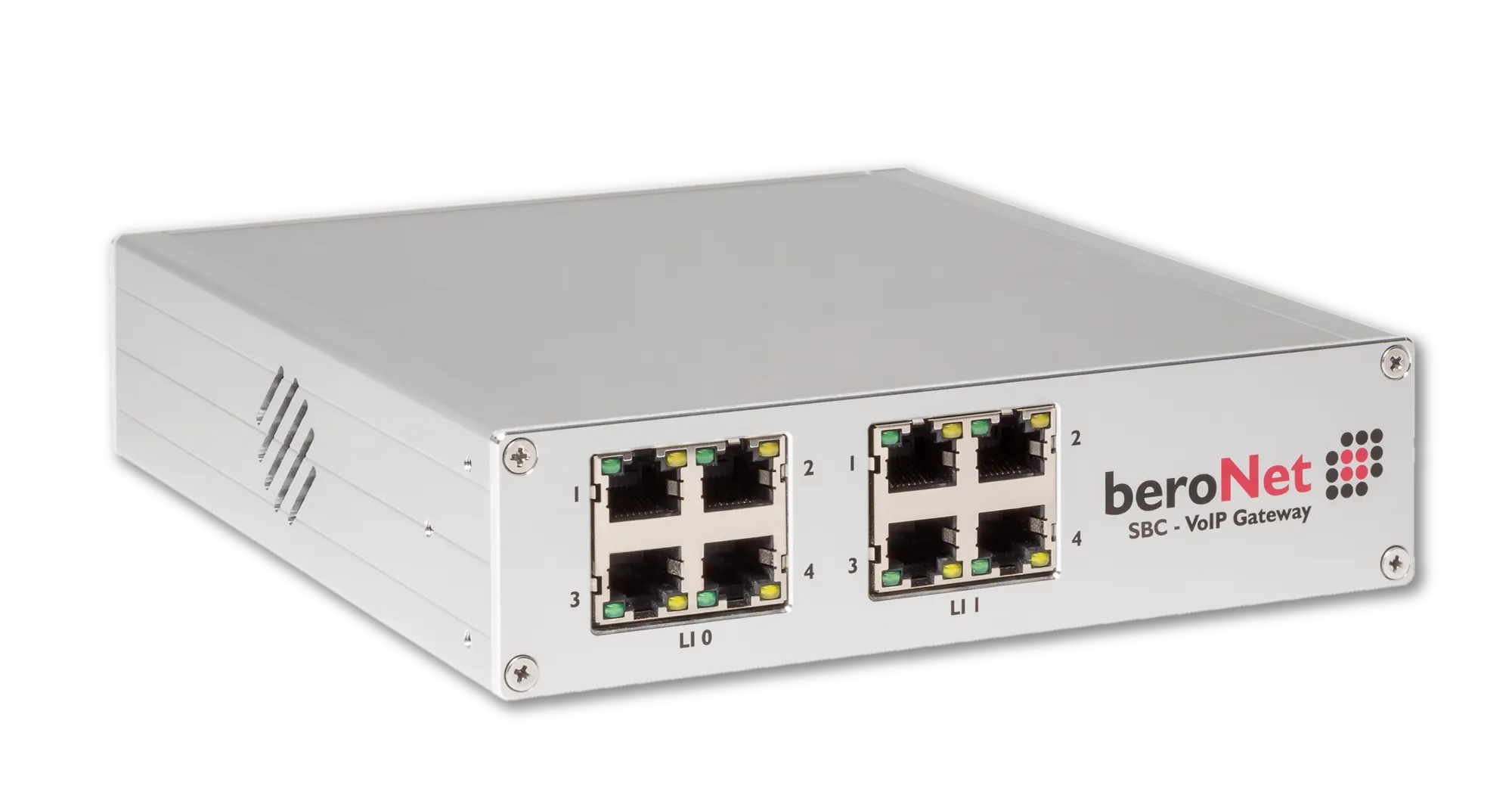
A SIP trunk puts the phone system one routing hop away from the open internet. The eSBC sits in that hop. It terminates the provider’s SIP session, hides the internal topology, filters what is allowed to reach the PBX at all and rewrites headers where provider and PBX disagree about numbering format, transport or codec. The PBX ends up talking to one known peer instead of to the internet.
The second job is the wiring that does not disappear on the day the contract changes. Two module slots take BRI, PRI, FXS, FXO or hybrid cards, so the same box also terminates an ISDN line, an analogue fax machine or a lift emergency telephone. When a site later moves to a pure SIP trunk, the module changes, not the device — which is the whole reason the platform is modular.
Sessions come in two kinds. Media that is passed through untouched is a transparent session; media that has to cross the hardware DSP because the two sides share no codec is a transcoded session. Both types can be mixed on one device and both are licensed per session. Calls between the PSTN interfaces and SIP — FXO, BRI or PRI to SIP — need no session licence at all. Only SIP-to-SIP traffic does.
Which size to pick follows the PSTN side and the amount of transcoding rather than the number of extensions. M and L share the same housing with two module slots; M carries 16 PSTN channels and 8 transcoded sessions, L 64 PSTN channels and 16 transcoded sessions. Both carry the same 128 transparent sessions and the same two network ports, and both include two transcoded SIP-to-SIP sessions.
The two interface worlds have their own pages: ISDN gateways for BRI and PRI, analogue gateways for FXS and FXO. The modules themselves are listed under add-on modules.
Features
- Separates the internal SIP network from the provider: topology hiding, SIP DoS detection, access control lists
- Rewrites SIP headers and converts between TCP and UDP, RTP and SRTP, and differing codecs
- Add-on modules for BRI, PRI, FXS and FXO turn the same device into an ISDN or analogue gateway
- Failover over PSTN or LTE
- Two network ports, remote configuration and firmware updates through beroCloud
- Aluminium housing, no moving parts, 1U, wall or 19-inch rack mounting
Technical specifications
| Module slots | Two, on BNSBC-M and BNSBC-L |
|---|---|
| Concurrent sessions | Up to 128 transparent; 8 (M) or 16 (L) transcoded |
| Included sessions | Two concurrent transcoded SIP-to-SIP sessions; more by licence |
| PSTN channels | 16 (M), 64 (L) |
| Network | Two 100 Mbit/s ports, LAN and WAN |
| Signalling | SIP user agent per RFC 3261 over UDP or TCP, optional TLS 1.2, SRTP |
| Voice | G.711 with G.168/G.165 echo cancellation up to 128 ms, voice activity detection, comfort noise, DTMF detection, T.38 fax relay |
| Power and size | 110-230 V, 12 V DC at 2 A; M and L 170 x 170 x 42 mm |
| Environment | Operating 0 to 40 °C with the supplied power supply, 0 to 70 °C with a power supply rated for this range; storage −20 to 70 °C; humidity 10–90 % operating, 5–95 % storage, non-condensing |
| Compliance | CE, FCC and ACMA |
Models and configurations
| SKU | Enterprise SBC | Concurrent sessions | PSTN channels | |
|---|---|---|---|---|
BNSBC-M | Two module slots, up to 16 PSTN channels | 128 / 8 | 16 | View in shop |
BNSBC-L | Two module slots, up to 64 PSTN channels | 128 / 16 | 64 | View in shop |
Frequently asked questions
Do calls between ISDN or analogue ports and SIP need a session licence?
No. Calls between the FXS, FXO, BRI or PRI ports and SIP need no session licence. Only SIP-to-SIP traffic, for example between a SIP provider and a SIP PBX, uses transparent or transcoded sessions.
What is the difference between a transparent and a transcoded session?
A transparent session passes the media through unchanged. A transcoded session sends the media through the hardware DSP because the two sides have no codec in common. Both are licensed per session and can be mixed on one device.
Can I change the interfaces later?
Yes. BRI, PRI, FXS and FXO interfaces are add-on modules. When the lines at a site change, a module is swapped or added in a free slot, and the device stays.
Does SIP over TLS or SRTP need an extra licence?
No. SIP over TLS 1.2 and SRTP need no licence of their own. SRTP can be set as optional or mandatory, with a choice of crypto suites.
How do certificates get onto the device, and is SCEP supported?
The certificate and its private key are created in your own PKI and loaded onto the device, separately for each network interface. The key length follows your PKI; 3072-bit RSA has been tested. SCEP is not supported; for larger rollouts, use DHCP options, the REST API or beroCloud.