
Analogue gateways
Analogue VoIP gateways: FXS and FXO to SIP
For everything that will never speak SIP: fax, alarm diallers, door intercoms, lift emergency telephones.
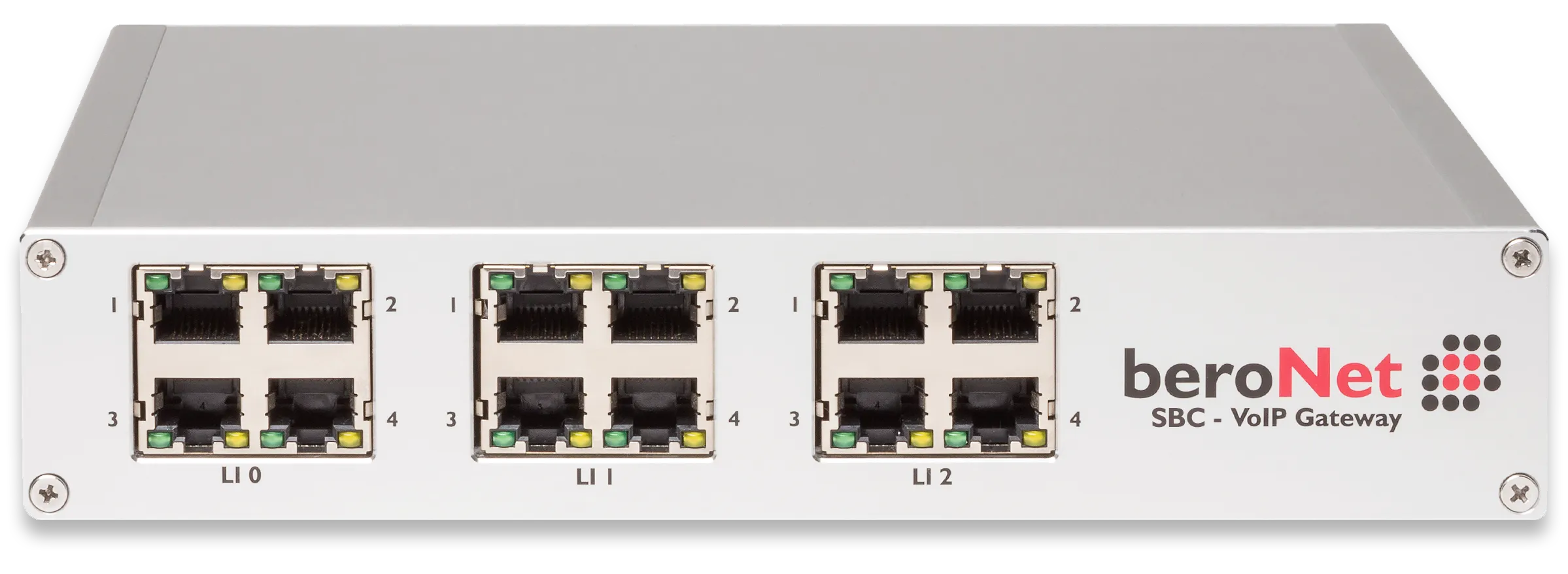
Analogue is where an all-IP migration usually gets stuck, and not because of telephones. It gets stuck at the fax machine in the accounts department, the alarm dialler with a maintenance contract, the door intercom that was wired into the building, and the lift emergency telephone that is required by law to work. None of those will ever speak SIP, and none of them can simply be switched off.
An FXS gateway gives them a port that behaves exactly as before while the line behind it is a SIP trunk. What makes that work for the awkward cases is transparent hardware bridging: fax and modem traffic crosses without a codec in the path, so the tones arrive as they were sent. Where a compressing codec would have destroyed the transmission, a clear channel per RFC 4040 carries it through.
FXO is the other direction. Instead of terminating equipment, the gateway terminates a line — an analogue provider line, or an analogue extension port on a PBX that has to stay in service. That is the usual bridge during a migration, and the usual failover path afterwards.
Four models are the modular eSBC platform with an analogue module fitted, so the interface can change later without changing the device. The BNSBC-12FXS is the exception: twelve fixed ports, built for hotels, student residences, hospitals and fax service providers, where the port count is the point. All of them are managed through beroCloud like the rest of the range.
Licensing, once more clearly: calls between the analogue ports and SIP need no session licence. Only SIP-to-SIP traffic consumes transparent or transcoded sessions.
For BRI and PRI on the same platform see ISDN gateways. The platform, its session licences and the full module range are on the Enterprise SBC and add-on modules pages.
Features
- FXS ports for analogue telephones, fax machines, modems, alarm diallers, door intercoms and lift emergency phones
- FXO ports to connect an analogue provider line or an analogue extension port of an existing PBX
- Fax and modem pass through as clear channel (RFC 4040); fax also via T.38 relay
- Calls between the analogue ports and SIP need no session licence; only SIP-to-SIP traffic is licensed
- CLIP and CNIP, message waiting indication as stutter tone and FSK
- Cloud managed through beroCloud, with the same web interface as the rest of the range
Technical specifications
| Interfaces | FXS for terminal equipment, FXO towards an analogue line or PBX port; four, eight or twelve ports |
|---|---|
| FXS characteristics | 0 V to -94.5 V, 3 to 5 REN depending on line length, 20 to 41 mA feed current; ringing frequency, amplitude, waveform and cadence programmable by country |
| Analogue features | CLIP and CNIP; message waiting indication as stutter tone and FSK; flash hook on FXO |
| Voice | G.711 with echo cancellation on up to 16 channels; G.723, G.726 and G.729; G.168/G.165 up to 128 ms |
| Fax and modem | T.38 fax relay (V.27, V.29 and V.17); clear channel per RFC 4040 for modem and fax over IP |
| SIP | RFC 3261 over UDP or TCP, optional TLS 1.2, SRTP; up to 128 transparent SIP-to-SIP sessions with licences |
| Housing | M and L 170 x 170 x 42 mm, 12 FXS 218 x 170 x 42 mm; 1U, wall or 19-inch mounting |
| Compliance | CE, FCC and ACMA on the 12 FXS; CE per EN 55022, EN 55024 and EN 60950 on the modular models |
Models and configurations
| SKU | Analogue gateways | Concurrent sessions | PSTN channels | |
|---|---|---|---|---|
BNSBC-M-4FXO | Four FXO | 128 / 8 | 4 | View in shop |
BNSBC-L-4FXO | Four FXO, one free module slot | 128 / 16 | 4 | View in shop |
BNSBC-M-4FXS | Four FXS | 128 / 8 | 4 | View in shop |
BNSBC-M-8FXS | Eight FXS | 128 / 8 | 8 | View in shop |
BNSBC-12FXS | Twelve FXS, non-modular | 128 | 12 | View in shop |
Frequently asked questions
Do I need a SIP licence for each FXS or FXO port?
No. Calls between the analogue ports and SIP need no session licence. Only SIP-to-SIP traffic uses transparent or transcoded sessions.
What is the difference between FXS and FXO?
An FXS port feeds analogue equipment such as telephones, fax machines, alarm diallers or lift emergency phones. An FXO port connects to an analogue provider line or to an analogue extension port of an existing PBX.
Can I connect fax machines and modems?
Yes. Fax can run as T.38 fax relay. Fax and modem traffic that must not pass through a compressing codec is carried as a clear channel per RFC 4040.
Will analogue telephones show who is calling?
Yes. The FXS ports send CLIP and CNIP, so the phone can display the caller's number and name. Ringing frequency, amplitude, waveform and cadence can be set per country, and message waiting is signalled as stutter tone or FSK.
Can I change the interfaces later?
On the modular models, yes: the analogue module can be replaced by another module type without changing the device. The BNSBC-12FXS has twelve fixed ports and is not modular.