
VoLTE SBC
VoLTE SBC — SIP to the mobile network
Successor to the GSM gateway: voice over LTE, with fallback to 2G and 3G.
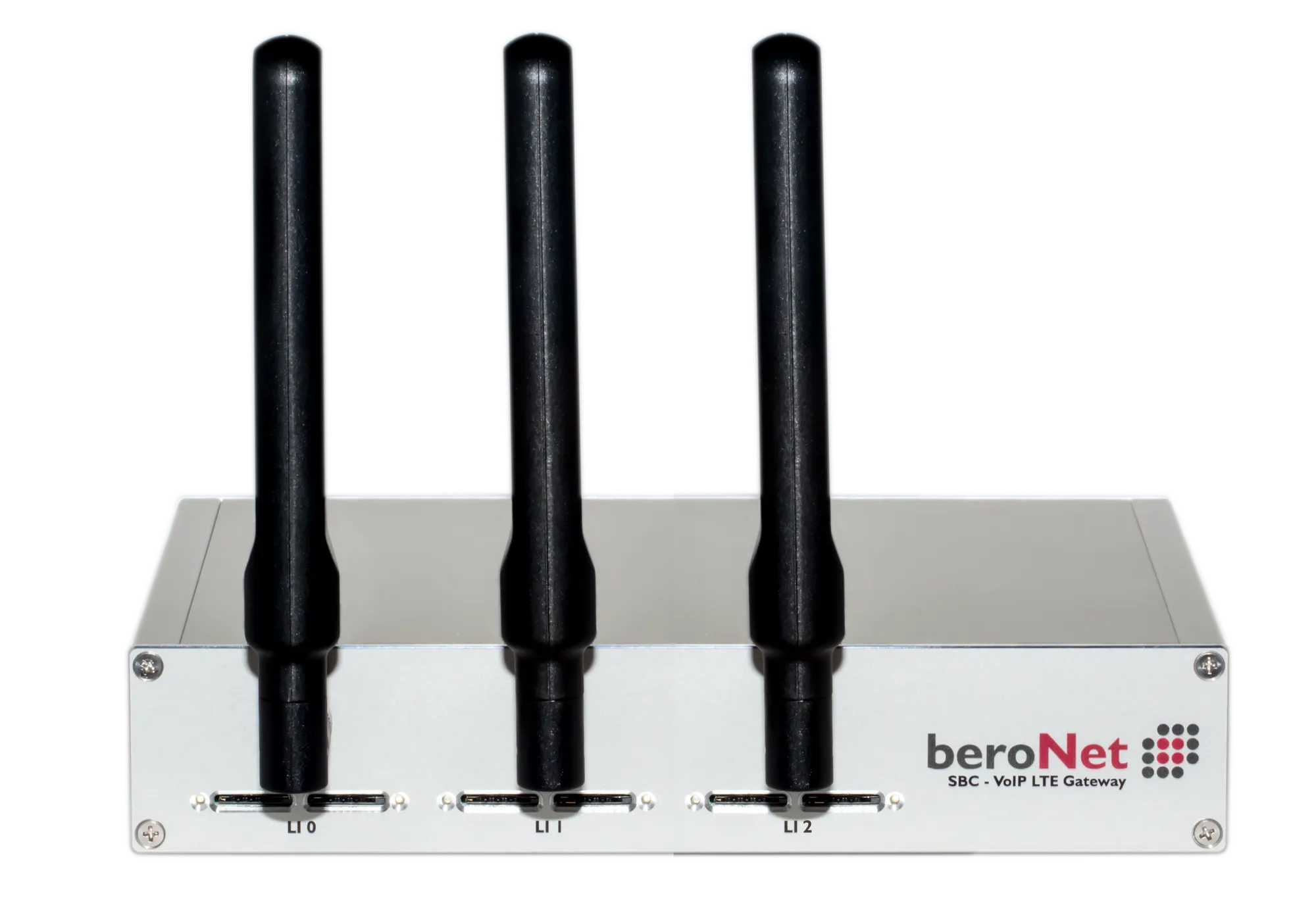
There are three reasons to put mobile radio into a telephone installation, and none of them is the mobile network itself. The first is a site that has no usable fixed line: a construction container, a wind farm substation, a shop in a building where the copper was never replaced. The second is failover — the SIP trunk is fine until the fibre is cut, and then every call has to go somewhere. The third is cost: calls into mobile networks are often cheaper from a SIM in the same network than through the fixed-line provider.
The VoLTE SBC covers all three from the same box. Two, four or six LTE ports carry voice and SMS, and the hybrid models add ISDN or analogue interfaces in the same housing, so the mobile path and the fixed-line path meet in one device with one dialplan instead of two boxes and a routing puzzle between them.
It is the successor to the GSM gateway and remains backward compatible: 2G and 3G still work, so an existing installation can be replaced without rewriting its plan. What improves is the voice path — VoLTE sets up calls faster and sounds better than a call over the 2G network.
On the SIP side it is a full eSBC. Two network ports, topology hiding, SIP DoS detection, header rewriting and codec conversion, with transparent and transcoded sessions licensed exactly as on the modular line. Calls between the mobile or PSTN interfaces and SIP do not consume a session licence; only SIP-to-SIP traffic does.
Features
- Two, four or six LTE ports, one SIM card per port, voice and SMS including concatenated messages
- Hybrid models add BRI, FXS or FXO in the same housing, so one device covers mobile and fixed line; other combinations on request
- Voice failover to mobile when the SIP trunk or the internet uplink goes down
- Full SBC function on the SIP side: topology hiding, SIP DoS detection, header rewriting, TCP to UDP and RTP to SRTP
- Also works on 2G and 3G where networks still offer them
- Remote management through beroCloud, including SIM and signal diagnostics
Technical specifications
| Mobile | 2, 4 or 6 LTE ports with one SIM each; 2G (GSM), 3G (UMTS) and 4G (VoLTE) |
|---|---|
| Bands | 2G: B3 (1800), B8 (900) · 3G: B1 (2100), B8 (900) · 4G: B3 (1800), B7 (2600), B20 (800), B1 (2100), B8 (900) |
| Messaging | SMS and concatenated SMS, text and PDU mode; supplementary services CLIP and CLIR |
| Channel count | The channel column adds the mobile channels and the ISDN or analogue channels of the hybrid models |
| Concurrent sessions | Up to 128 transparent SIP-to-SIP; 8 transcoded on M models, 32 on L models |
| Voice | G.711 with G.168/G.165 echo cancellation up to 128 ms; G.723.1 with Annex A, G.729 a/b and G.726 on up to four channels |
| Network | Two 100 Mbit/s ports; SIP per RFC 3261 over UDP or TCP, optional TLS 1.2, SRTP |
| Power and size | 110-230 V, 12 V DC at 2 A, 6 W average and 24 W peak; M and L 170 x 170 x 42 mm, M 800 g |
| Antennas | Ships with 14 cm stock antennas; magnetic-foot antenna with 5 m or 10 m cable available |
| Compliance | CE, FCC and ACMA |
Models and configurations
| SKU | VoLTE SBC | Concurrent sessions | PSTN channels | |
|---|---|---|---|---|
BNSBC-M-2LTE | Two LTE | 128 / 8 | 2 | View in shop |
BNSBC-M-4LTE | Four LTE | 128 / 8 | 4 | View in shop |
BNSBC-M-6LTE | Six LTE | 128 / 8 | 6 | View in shop |
BNSBC-M-2LTE4FXS | Two LTE and four FXS | 128 / 8 | 6 | View in shop |
BNSBC-M-2LTE4FXO | Two LTE and four FXO | 128 / 8 | 6 | View in shop |
BNSBC-M-2LTE2S02FXS | Two LTE, two BRI and two FXS | 128 / 8 | 8 | View in shop |
BNSBC-M-2LTE4BRI | Two LTE and four BRI | 128 / 8 | 10 | View in shop |
BNSBC-L-2LTE1PRI | Two LTE and one PRI | 128 / 16 | 32 | View in shop |
BNSBC-M-4LTE4FXS | Four LTE and four FXS | 128 / 8 | 8 | View in shop |
BNSBC-M-4LTE4FXO | Four LTE and four FXO | 128 / 8 | 8 | View in shop |
BNSBC-M-4LTE2S02FXS | Four LTE, two BRI and two FXS | 128 / 8 | 10 | View in shop |
BNSBC-M-4LTE4BRI | Four LTE and four BRI | 128 / 8 | 12 | View in shop |
BNSBC-L-4LTE1PRI | Four LTE and one PRI | 128 / 16 | 34 | View in shop |
Frequently asked questions
Can the VoLTE SBC take over calls when my SIP trunk fails?
Yes. When the SIP trunk or the internet uplink goes down, voice calls fail over to the mobile network. For a backup path that does not depend on a single carrier, use SIM cards from different networks.
Can I connect an ISDN or analogue PBX to the mobile network?
Yes, with a hybrid model: it adds BRI, PRI, FXS or FXO ports to the LTE ports in the same housing. Both sides meet inside the device over SIP, and one dialplan decides whether a call goes over the mobile network or the fixed line.
Does the VoLTE SBC support eSIM?
No. Each LTE port takes one physical SIM card; eSIM is not currently offered.
Can I add more LTE ports to my device later?
Not as a standard option: the LTE ports are fitted at the factory. beroNet has already upgraded devices for individual customers, so if you need more LTE ports, get in touch. Otherwise choose a model with four or six LTE ports, or add a second unit.
Does it need beroCloud or an internet connection to make calls?
No. The device connects to the mobile network itself and hands calls to a local PBX over SIP, with no cloud service in between. beroCloud adds remote management but is not needed for calls.
Can applications send and receive SMS?
Yes. A local, authenticated API sends and receives SMS with a choice of SIM and works without beroCloud. It is documented in the beroNet Wiki.